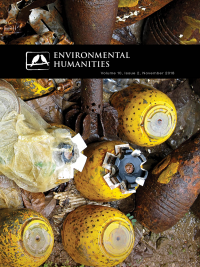
"Weak Seed and a Poisoned Land: Slow Violence and the Toxic Infrastructures of War in South Lebanon"
Through ethnographic fieldwork in southern Lebanon, Vasiliki Touhouliotis examines the 2006 Lebanon-Israeli war’s environmental impact.
The author works on the notion of “watershed encounter” as a diverging point in history to analyze which watershed encounters shaped the Chesapeake Bay region. He argues that current restoration efforts, far from solving the current issues, only exacerbate them.
The authors detail their experience of Puchuncavi, the largest, oldest, and most polluting industrial area in Chile. They approach it from a multidisciplinary viewpoint as an experience of the Anthropocene and advocate for an enhanced pedagogy of care born of our inherited pasts and of engagement, interest, and becoming as response-ability.
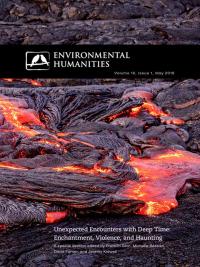
Christine Hansen uses the concept of deep time to challenge the idea that never-before-witnessed events are unprecedented. Using the case of a massive firestorm in 2009 in southeast Australia, she calls into question the shallow temporal frames through which deep time environmental phenomena are understood in Australian settler culture and offers an insight into often unnoticed ways in which contemporary society struggles with the colonial legacy.
This article focuses on contemporary literary and musical interpretations of changing relationships between humans and the environment in Mongolia. The author explores how these works relate to deep time, and crosshatches biographical, mythological, and geologic understandings of time.
The authors put forward the idea of “speculative geology” to explain the violence inherent in volcanism, drawing on three volcanic episodes and the more recent unexpected striking of magma in Iceland’s Krafla volcanic caldera.
The authors analyze the portrayal in popular conservation discourse of the flowering plant Rhododendron ponticum as an invasive species in the British countryside, especially Scotland. They explore how its invasiveness is materially produced via the cultural and socioeconomic as well as vegetal relations within which it is entangled.
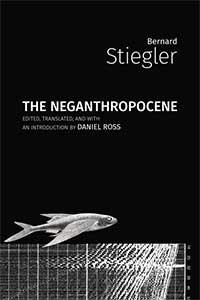
The Neganthropocene is a collection of essays and lectures focusing on the Anthropocene and the vast semantic horizon it encompasses, from philosophy to politics and the arts, through a renewed thought of the concepts of entropy and negentropy.
Synthesizing ethnographic case studies from mainland Southeast Asia, the authors critically review the implementation of REDD+, a UN project to reduce emissions from deforestation and forest degradation. They argue that REDD+ maps onto local power structures and political economies in its implementation, rendering it blunt as a tool for change.
This article explores the past and future of one of Mumbai’s largest city forests.