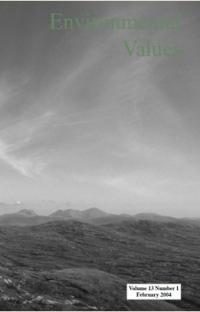
"‘Like a Stone’: Ecology, Enargeia, and Ethical Time in Alice Oswald's Memorial"
Through readings of the works of artist/sculptor Ilana Halperin and poet Alice Oswald, David Farrier explores the idea of Anthropocene as marked by haunted time.

In this special issue on Disempowering Democracies, Emmanuel O. Nuesiri critically examines the United Nations’ REDD and REDD+ programmes (Reducing Emissions from Deforestation and forest Degradation plus the sustainable management of forest and enhancement of carbon stocks) in Nigeria and finds them to exclude politically weak rural people.
A discussion on the terms multispecies, non-human, and more-than-human.
The aim of this paper is to consider more closely how uncertainty affects our moral responsibility to future generations, and to what extent moral agents can be held responsible for activities that inflict risks on future people.
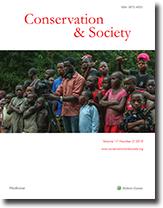
This paper uses a comparative case study approach to explore the individual and societal desire to maintain current lion populations alongside communities in Zimbabwe’s Hwange National Park, Tanzania’s Ruaha National Park, and Kenya’s southern Maasailand.
In this introduction to a special section on toxic embodiment, Olga Cielemęcka and Cecilia Åsberg examine variously situated bodies, land- and waterscapes, and their naturalcultural interactions with toxicity.
Article by Rachel Carson Center alumna Mengxi Kou and colleagues on how protected areas can conserve wildlife while also safeguarding people’s livelihoods.
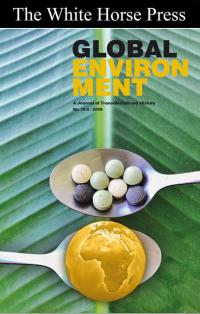
Editorial to “Imagining Planetary Health,Wellbeing and Habitability: Perspectives from the Environmental Humanities,” a special issue of Global Environment.
In view of the escalating environmental crisis, the democratic states of the Global North must ecologically transform their social and constitutional orders.