

Multimedia | journal article
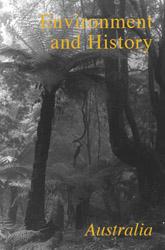
"Editorial" for Environment and History 4, no.2, Australia special issue (June, 1998)
There is an urgency and a fracture to Australian environmental history…
There is an urgency and a fracture to Australian environmental history…
A nuanced treatment of the relation between peasant protests and environment with reference to a broad range of examples from Mediterranean Europe, Latin America, Asia, and Africa.

A discussion on the terms multispecies, non-human, and more-than-human.
In his article for the special section “Living Lexicon for the Environmental Humanities,” Cameron Muir asks, “how do we respond to the broken, as scholars, writers, artists? And what can the broken tell us?”

Shannon Cram explores the slippery subjectivities of nuclear waste and nature at Washington State’s Hanford Nuclear Reservation, examining how this space is framed as both pristine habitat and waste frontier. She examines Hanford’s biological vector control program through the fruit fly and discusses how vector control uses instances of nuclear trespass to articulate the boundary between contaminated and uncontaminated. She concludes that nature is being recruited to do what the U.S. Department of Energy cannot: solve Hanford’s nuclear waste problem.

By privileging music as a focus for applied ecology, Robin Ryan aims to deepen perspectives on the musical representation of land in an age of complex environmental challenge.

In this article, Sasha Litvintseva examines the history and materiality of asbestos to theorize toxic embodiment through the mutuality of the haptic sense and the breaching of boundaries of inside and outside. She develops this through an analysis of her own film project Asbestos (2016), shot at the mining town of Asbestos, Quebec.
Through a case study of the “invasive alien species” (IAS) narrative in South Africa, Susanna Lidström, Simon West, Tania Katzschner, M. Isabel Pérez-Ramos, and Hedley Twidle suggest that IAS oversimplifies the webs of ecological, biological, economic, and cultural relations to a simple “good” versus “bad” battle between easily discernible “natural” and “nonnatural” identities.
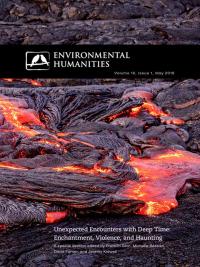
The authors detail their experience of Puchuncavi, the largest, oldest, and most polluting industrial area in Chile. They approach it from a multidisciplinary viewpoint as an experience of the Anthropocene and advocate for an enhanced pedagogy of care born of our inherited pasts and of engagement, interest, and becoming as response-ability.
Alok Amatya studies the depiction of indigenous struggles against the grab of minerals, crude oil, and other natural resources by private and government corporations in works such as Arundhati Roy’s travel essay Walking with the Comrades (2010). He suggests that narratives of conflict over the extraction of natural resources can be studied as the corpus of “resource conflict literature,” thus generating a global comparative framework for the study of contemporary indigenous struggles.