


Multimedia | journal article
“The Unbearable Weight of Displaced Weather”
Human geographer Mike Hulme looks at sociotechnical developments that have changed the climate and, at the same time, the way we experience the weather.
Human geographer Mike Hulme looks at sociotechnical developments that have changed the climate and, at the same time, the way we experience the weather.
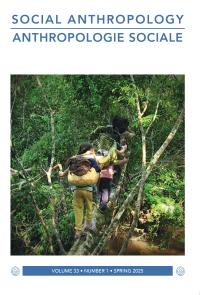
Chapters from the Social Anthropology/Anthropologie Sociale special issue “Child Socialisation and Environmental Transformation in Indigenous South America,” edited by Jan David Hauck and Francesca Mezzenzana.
This article calls for a re-envisioning of the blue economy through the eyes of coastal communities and their socio-ecological relations.
Kata Beilin’s short story narrates of a scholar’s Amazonian journey, which awakens her from ambition’s illusion to the deeper truth of the interbeing in the forest.
Amrita Dasgupta shows how the littoral sex workers of the Mongla brothel struggle to make a livelihood in the face of climate change.
The work of two biologists in remote forests shows that species recovery depends on both data and human–animal bonds forged in the field, as Monica Vasile writes.
Flora Mary Bartlett captures the flows between lab and landscape through photographic exploration.
The essay acquaints readers with an ecocritical approach to comics by close reading three recent “ecocomics” with an emphasis on thematic and formal features.

Drawing upon archival records in Namibia, South Africa, Portugal, the United States, and the United Kingdom, this article argues that concerns over the spread of plague across land borders led to the development of a nascent invasive species framework which indicted border-crossing “migrant” South African gerbils for the international spread of the disease.

This article traces the gradual expansion and scientific standardization of weather forecasting, and highlights the real intent of the British government.