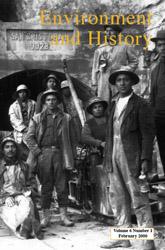
"Environment and Society: Long-Term Trends in Latin American Mining"
Drawing on historical and environmental research, this essay examines long-term trends in the ways that mining affected labour and the environment in Latin America.
This study argues that when farmers raised concerns about miners’ activities, ‘precautionary stewardship’ of the environment designed to stop entrepreneurial practices harmful to the environment was not a concern. This was a struggle over the ownership of the means of production by two competing forms of capitalism—a characteristic intra-class as well as intra-racial conflict.
This exploration of the deepening crisis of food security in India looks at four case studies, dealing respectively with Punjab, Warangal, Kalahandi, and Bellary. These are interspersed by insights into a movement in the Himalayas that may offer alternatives in the form of sustainable agricultural systems, which revive traditional agricultural practices (Beej Bachao Andolan).
Investigates the significance of the Sundarbans as a natural reserve or buffer area (a resource of yet unknown magnitude) in pre-colonial, colonial, and post-colonial South Asia.
An examination of the origin, development, and future of environmental history in Spanish historiography.
This book discusses Marx’s ecological principles and materialistic views that can be traced back to mid-nineteenth-century social and scientific thought.
The second volume of Robbins’s environmental history of Oregon.
In his paper, Charles C. Mueller sheds light on the economics of survival, a branch of ecological economics that stresses the preservation of the opportunities of future generations over an extended time horizon.
This paper offers an ethico-political interpretation of primitivism’s critical relation to modernity in terms of the dialectic between amorality (innocence) and immorality (guilt) within what is characterized as modernity’s “culture of contamination.”