


Arcadia
Animal Rights vs. Bullfights: The Horns of an Indian Dilemma
Animal rights prevailed over bullfights in a recent judgment of the Supreme Court of India.
Animal rights prevailed over bullfights in a recent judgment of the Supreme Court of India.
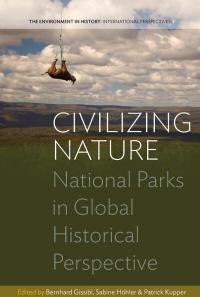
National parks are one of the most important and successful institutions in global environmentalism. Shifting the focus from the usual emphasis on national parks in the United States, Civilizing Nature adopts an historical and transnational perspective on the global geography of protected areas and its changes over time.
This article analyzes how World War II impacted both the marine and the terrestrial environment of the North Atlantic, triggered major political and economic decisions with profound cultural implications, and eventually induced a change in ocean management.

This article reflects on the Knechtsand, a sandbank in the estuary of the Weser, that served as a bombing range for the British and American air forces stationed in England in 1952. It examines the locals’ protests historically and uncovers strands of tradition that are hugely significant for our understanding of the Wadden Sea and the expanding conservation regime.
This article introduces this issue of Conservation and Society, and argues strongly for new place-based conservation through a multispecies lens.

The categories and the types of care we assign are very often tenuous and troubled in nature. The articles in this volume explore some of the intricacy, ambiguity, and even irony in our perceptions and approaches to “multispecies” relations.
Jean Langford discusses what happens “when species fall apart” in the relationships of care at primate and parrot sanctuaries. Care involves an improvised orchestration of social life—through spatial arrangements and regulation of movement—to facilitate often nonnormative, intraspecies, and cross-species intimacies.
Caring for one set of species at the cost of another is the subject of Amir Zelinger’s article about bird conservation and its implications for the life of cats in Imperial Germany.
Ursula Münster shows us in her essay on silenced and silent practices of avian care in a postcolonial conservation landscape of South India, that care is never innocent, it plays out within established hierarchies and power relations, and it can reinforce long traditions of imperialism and exclusion.