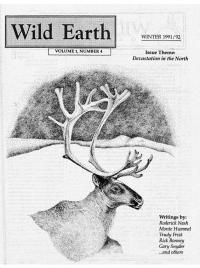
Wild Earth 1, no. 4
Wild Earth 1, no. 4. on Canadian wilderness laws and national parks, how a proposed copper mine in Canada is threatening the rivers Tatshenshini and Alsek, and the hidden costs of developing natural gas reserves.
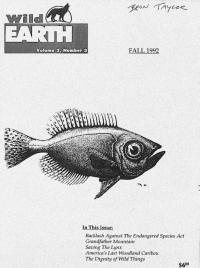
Wild Earth 2, no. 3 about the Endangered Species Act, saving the Lynx, bioregionalism, and America’s last woodland caribou.
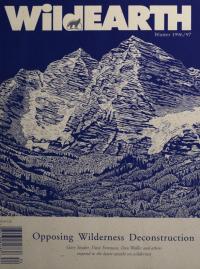
Wild Earth 6, no. 4 features essays opposing wilderness deconstruction. Gary Snyder writes on nature as a social construction, Dave Foreman contributes a piece on the conservation opposition’s underlying views, and Don Waller discusses the evolution of wilderness concepts.
John M. Francis discusses nature conservation and the precautionary principle.
Stanley Warner, Mark Feinstein, Raymond Coppinger, and Elisabeth Clemence discuss global population growth and the demise of nature, appealing for a change in the nature of the discussion of population among environmentalists, to focus on the question of how best to manage remaining wildlife.
Richard B. Harris discusses China’s policies in wildlife conservation, particularly with regard to endangered species to suggest that Western criticisms of Chinese utilitarian attitudes are inappropriate, ineffective, and possibly counter-productive.
John S. Akama, Christopher L. Lant, and G. Wesley Burnett use a political-ecological framework in the analysis of the social factors of wildlife conservation in Kenya.
Brian K. Steverson argues against James Sterba’s attempt to show that anthropocentrists and nonanthropocentrists would accept the exact same principles of environmental justice.
Michael Mason argues that Habermasian moral theory reveals a key tension between, on the one hand, an ethical commitment to wilderness preservation informed by deep ecological and bioregional principles that is oriented to a naturalistic value order and, on the other, the procedural norms of democratic participation.
David Schmidtz argues that “the philosophies of both conservation and preservationism can fail by their own lights, since trying to put their respective principles of conservationism or preservationism into institutional practice can have results that are the opposite of what the respective philosophies tell us we ought to be trying to achieve.”