

Arcadia
Ancestral Outdoorsmen and Historical Hikes
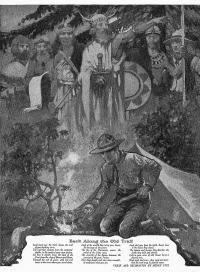
These Boy Scout images, particularly focused on the 1919–1925 era, demonstrate that human labor and history permeated popular American nature ideology and hiking practices at that time.
These Boy Scout images, particularly focused on the 1919–1925 era, demonstrate that human labor and history permeated popular American nature ideology and hiking practices at that time.
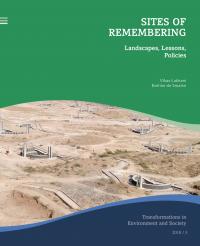
Bolton explores how Natural England creates landscape management plans in partnership with local communities.
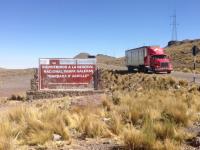
In the 1980s, Bárbara d’Achille traveled through Peru as one of the country’s first environmental writers and activists.
Micheal Richardson investigates the impact of envisioning climate catastrophe in three works, namely George Miller’s film Mad Max: Fury Road (2015), Marina Zurkow’s animation Slurb (2009), and Briohny Doyle’s novel The Island Will Sink (2016).
Xenia Cherkaev and Elena Tipikina examine the institutions of the Stalinist state that planned the distribution, raising, and breeding of family dogs for military service. The investigate how the program affected human-dog relations.
Erika Amethyst Szymanski investigates the impact of synthetic yeast, which is gaining ground in a variety of foodscapes, and reflects upon the meaning of Terroir that synthetic yeast brings about.
Petra Tjitske Kalshoven combines ethnographic studies with ornithological testimonies to present the re-creation and reenactment of the extinct great auk, or garefowl. The author aims to achieve contiguity with lost species through expressions and shaping of human perceptions and imaginations of past, and eventually future, environmental disasters.
The authors detail their experience of Puchuncavi, the largest, oldest, and most polluting industrial area in Chile. They approach it from a multidisciplinary viewpoint as an experience of the Anthropocene and advocate for an enhanced pedagogy of care born of our inherited pasts and of engagement, interest, and becoming as response-ability.
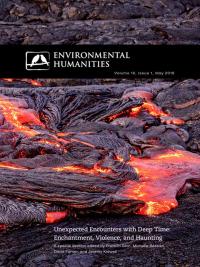
The authors introduce a special section of Environmental Humanities on manifestations of deep time through places, objects, and practices, focusing on three modes through which it is encountered: enchantment, violence, and haunting.
Considering Caroline Wendling’s living artwork White Wood (2014) in northeast Scotland, the author examines the relationship between deep time, ecology, and enchantment.