


Multimedia | film profile
Banking Nature
This film examines the pros and cons of the financialization of nature, an approach which some believe can make up for failed political solutions.
This film examines the pros and cons of the financialization of nature, an approach which some believe can make up for failed political solutions.
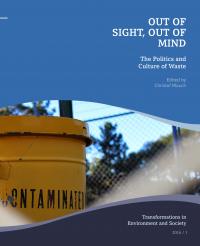
Waste is never completely or permanently “out of sight.” Once discarded, it undergoes transformations, often reappearing elsewhere in new forms. In this volume of RCC Perspectives, scholars from different disciplines—from history and art history, urban geography, environmental studies, and anthropology—investigate the traces waste leaves behind in the course of its travels.
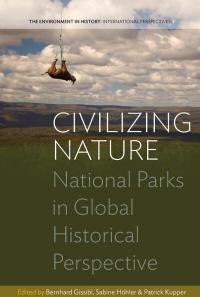
National parks are one of the most important and successful institutions in global environmentalism. Shifting the focus from the usual emphasis on national parks in the United States, Civilizing Nature adopts an historical and transnational perspective on the global geography of protected areas and its changes over time.
This article discusses the need to broaden the debate about land rush by including a few key issues that have been neglected. Control over land is increasingly dictated by global actors and processes, leading to a patchwork of locally disembedded land holdings, not conducive for inclusive and sustainable development at the local level.

International Organizations and Environmental Protection comprehensively explores the environmental activities of professional communities, NGOs, regional bodies, the United Nations, and other international organizations during the twentieth century. It follows their efforts to shape debates about environmental degradation, develop binding intergovernmental commitments, and—following the seminal 1972 Conference on the Human Environment—implement and enforce actual international policies.
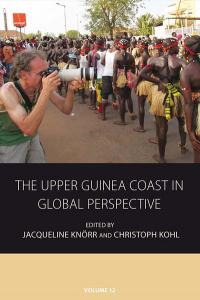
The Upper Guinea Coast in Global Perspective takes an anthropological approach to Africa’s Upper Guinea Coast. It portrays a historically globalized region which has adapated creatively to major transformations and still remains a major actor within global networks.

Nicholas Babin´s review of the book Organic Sovereignties by Guntra A. Aistara.
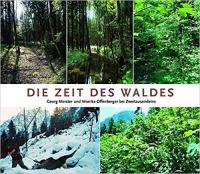
Through a collection of 445 photographs taken from precisely the same places at intervals of months, years and decades,Die Zeit des Waldes [The forest over time] offers a stop-action look at the diversity of transformations within Germany’s forests.
Based on 25 interviews with Australian environmental leaders, the authors assess the value and benefit of the World Heritage Convention and the UNDRIP in relation to Indigenous communities and cosmopolitanism.
This collection of essays maps the heterogeneous and asymmetrical ecologies within which we are enmeshed, a material world that makes the human possible but also offers difficulties and resistance.