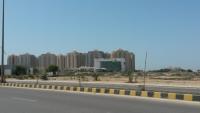
The Lake That Became a Sports Stadium
The transformation of the Sampangi Lake into the present-day Sri Kanteerava Stadium.
Kamaljit Kaur Sangha and Jeremy Russell-Smith propose an integrated ecosystem services (ES) valuation framework for an indigenous savanna estate in northern Australia, describing how capabilities along with biophysical and socio-cultural ES benefits play a vital role for peoples’ well-being.
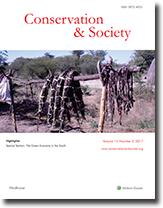
Allison L. Mayberry, Alice J. Hovorka and Kate E. Evans use qualitative methods to explore human experiences with elephants and perceived impacts of elephants on human well-being in northern Botswana. They emphasize the importance of investigating both visible and hidden impacts of elephants on human well-being to foster holistic understanding of human-elephant conflict scenarios and to inform future mitigation strategies.
Sorrel Jones, Malcolm D. Burgess, Frazer Sinclair, Jeremy Lindsell and Juliet Vickery present new data on rule-breaking prevalence in Gola Rainforest National Park, Sierra Leone, and use these data in spatially explicit simulations to assess the survey effort and design required to detect change and assess the effect of rule-breaker behavior to these designs.
In this Special Section on the Green Economy in the South, V. Corey Wright contributes to the debate about Tanzania’s Wildlife Management Areas (WMAs) and the nature of decentralization. He argues that WMAs represent risk but also an opportunity for rural communities.
Susana Costa, Catarina Casanova, and Phyllis Lee present a study of the obstacles to women’s participation in conservation strategies associated with Cantanhez Forest National Park (CFNP), in Guinea-Bissau, West Africa. The findings revealed that the women felt the Park was responsible for malnutrition in the communities due to damage of crops by wildlife.
Carter et al. translate key themes from scenario narratives into spatial representations using Geographic Information Systems (GIS). They apply this technique to a Tasmanian case study exploring future scenarios for biodiversity in a predominantly privately-owned agricultural landscape, enabling land managers to explore outcomes from potential interventions and identify strategies that might mitigate the impact of future issues of environmental concern.
Kimberly R. Marion Suiseeya draws attention to the persistent justice debates in Reduced Emissions from Deforestation and Degradation plus the enhancement of carbon stocks (REDD+) and the role of norms in constraining and shaping policy designs and outcomes.
Virtual water is heralded as the solution to freshwater scarcity and overconsumption, but it oversimplifies global water flows.
This article investigates how plants are supported by systems of ethno-political, military, and neoliberal power in urban Pakistan.