"Re-framing Flood Control in England and Wales"
In their article, William R. Sheate and J. Ivan Scrase argue that for a risk-oriented framing to succeed, new assumptions about causation and a new ethical outlook are now needed.
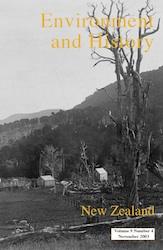

The history of environmental anxiety in nineteenth- and twentieth-century New Zealand can be traced by focusing on problems caused by deforestation.
Human geographer Mike Hulme looks at sociotechnical developments that have changed the climate and, at the same time, the way we experience the weather.
This article argues that local religious institutions are used by ruling lineages for political control, to grant preferential access to particular resources, and to enhance political hegemony.
Michael Marder interprets the “toxic flood” we are living or dying through as a global dump. On his reading, multiple levels of existence—from the psychic to the physiological, from the environmental-elemental to the planetary—are being converted into a dump, a massive and still growing hodgepodge of industrial and consumer by-products and emissions; shards of metaphysical ideas and theological dreams; radioactive materials; light, sound, and other modes of sensory pollution; pesticides and herbicides; and so forth.
This article seeks to shed light on some of the many possible interactions between changes in rainfall regime, one of the climatic factors with the greatest bearing on the history of human society, and the economic and socio-environmental dynamics of Costa Rica.