

Multimedia | journal article
"The Politics of Environmental Knowledge"
Using examples from environmental governance and conservation, Esther Turnhout engages critically with the ideal of policy-relevant environmental knowledge.
Using examples from environmental governance and conservation, Esther Turnhout engages critically with the ideal of policy-relevant environmental knowledge.
Looking at cases of Indigenous land and sea management in Australia, Austin et al. suggest four ways Indigenous groups and institutional investors can work together to establish meaningful criteria for ensuring effective conservation outcomes.
Andrés León Araya reviews Jim Igoe’s The Nature of Spectacle: On Images, Money, and Conservation Capitalism.

In this special section on Green Wars, Bram Büscher examines the case of rhino poaching in South Africa, arguing that we are seeing the uneven emergence of new geographies of conservation focused on preempting threats (ontopower).
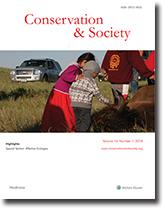
In this special section on affective ecologies, Julia Hobson Haggerty, Elizabeth Lynne Rink, Robert McAnally, and Elizabeth Bird study the restoration of bison/buffalo by the Sioux and Assiniboine tribes to their reservation in Montana in the United States. They argue that ecological restoration can promote and facilitate emergent and dynamic processes of reconnection at the scale of individuals, across species and within communities.
Aimee L. Schmidt and Douglas A. Clark examine the response of local people and agencies to a polar bear-inflicted human injury in Churchill, Manitoba, Canada, showing how human-bear conflict is often widely publicized and controversial, and how it shapes public expectations around bear management.
Ryan Hackett reviews Jessica Dempsey’s book Enterprising Nature: Economics, Markets and Finance in Global Biodiversity Politics.
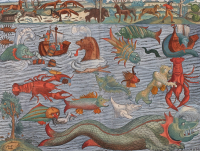
This article looks at changing perceptions of whales along the coasts of Portugal.

This film presents the interdisciplinary and international project BASYS (Baltic Sea System Studies), financed by the European Union in the years 1996 to 1999, which investigated many aspects and influences of mankind activities on the ecosystem Baltic Sea as well as the natural influences such as climate and weather. A large database accessible to all scientists was collected during the project and should help in the future to distinguish between the natural and human effects upon the ecosystem of the Baltic Sea.

This chapter from the virtual exhibition “The Life of Waste” discusses the origins of waste, our methods of consumption and the consequent production of waste, and how we learn to waste.