


Multimedia | book excerpt
American Canopy: Trees, Forests, and the Making of a Nation
Eric Rutkow shows that trees were essential to the early years of the republic and indivisible from the country’s rise as both an empire and a civilization.
Eric Rutkow shows that trees were essential to the early years of the republic and indivisible from the country’s rise as both an empire and a civilization.
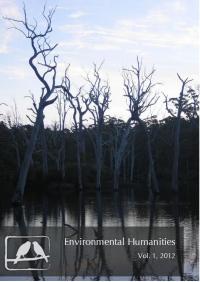
The Editorial Team offers an introduction to the journal Environmental Humanities.
The philosopher Timothy Morton is using the Oedipal logic to explain the human shift from a creature inferior to nature to a geophysical force on a planetary scale and to think about possible solutions for an accordingly upcoming bitter end.
Eben Kirksey on how diverging values and obligations shape relationships in multi-species worlds.
Tom Lee on the dynamism and complexity of the relationship that exists between differing kinds of knowledge.
Libby Robin explores four key drivers of conservation initiatives: place, landscape, biodiversity, and livelihood.
Laurel Peacock on Brenda Hillman’s ecopoetic practice and how we can shift our understanding of our affective relationship to the environment.
Natalie Porter analyses a participatory health intervention in Việt Nam to explore how avian influenza threats challenge long-held understandings of animals’ place in the environment and society.
Alex Lockwood tries to measure the importance of Rachel Carson’s work in its affective influence on contemporary environmental writing across the humanities.
Anna Tsing’s essay opens a door to multispecies landscapes as protagonists for histories of the world.