Earth First!: "The War at Home: Headwaters Forest Still Threatened"
This 1988 newsletter was created by the Earth First! Redwood Action Team. It includes updates on court hearings and lawsuits, preservation proposals, and a call to action.

Fei Sheng traces the development of environmental non-government organizations (ENGOs) in China, and describes the challenges they face in the political and cultural spheres.
William Major examines the need to understand pacifism and environmentalism as essentially consonant philosophies and practices.
Eileen Crist critiques the recent proposal to name our current geological epoch “the Anthropocene.”
By theorizing the temporalities of political-economic transformations as embodied in key conservationist and educational institutions, Erin Fitz-Henry argues that we can deepen our understanding of “worlds-otherwise” and work toward clarifying the institutional conditions that mitigate their flourishing.
Les Beldo proposes thinking about nonhuman contributions to production, including those taking place at the microbiological level, as labor, and offers an ethnographic description of the lives of broiler chickens.
Vardy and Smith’s article for the Living Lexicon for the Environmental Humanities argues that “resilience signals the pernicious return of structural-functionalism precisely at the moment when much more nuanced, thoughtful, and critical attention should be given to the relationships and differences between and within human and nonhuman populations.”
Gregg Mitman examines the relationship between issues in early twentieth-century American society and the sciences of evolution and ecology to reveal how explicit social and political concerns influenced the scientific agenda of biologists at the University of Chicago and throughout the United States during the first half of the twentieth century.
Wrenched captures the passing of the monkey wrench from the pioneers of eco-activism to the new generation who carries Edward Abbey’s legacy into the 21st century. The fight continues to bring awareness to the need for protection of the last bastion of the American wilderness - the spirit of the West.
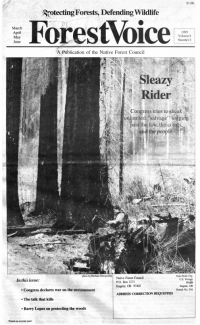
This issue of Forest Voice, a publication of the Native Forest Council, showcases the work of the NFC, of other activist groups, and of citizens to investigate legal action on forest plans. It focuses on Congress efforts to sneak unlimited “salvage” logging past the law and the people. Victor Rozek draws a connection between inflammatory rhetoric and violence. In his column, Howie Wolke reflects on the large-scale grassroots “uprising” as a strategy for conservation groups dealing with politicians.