


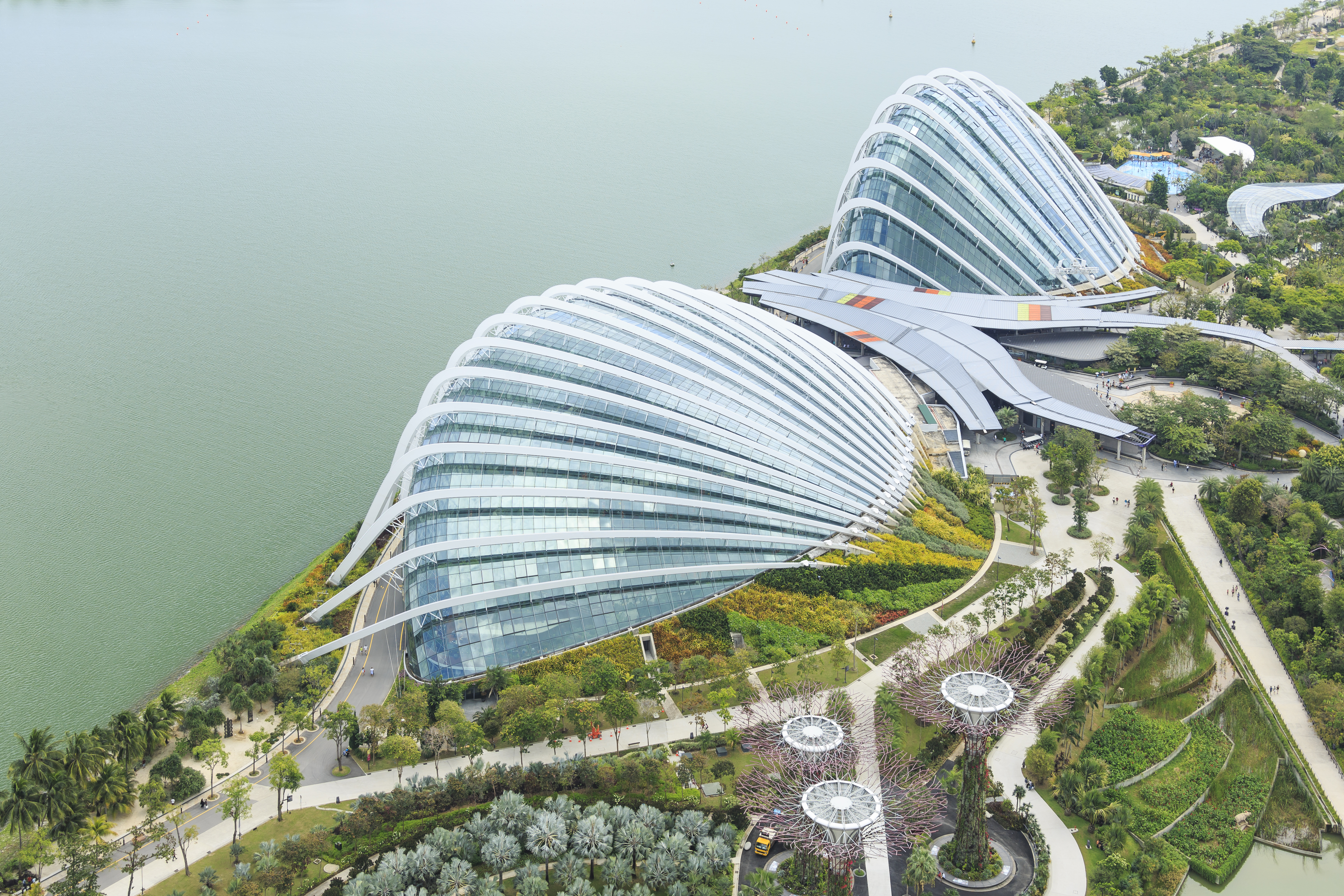
The Flower Dome and the Cloud Forest, two conservatories in the Gardens by the Bay, Singapore.
The Flower Dome and the Cloud Forest, two conservatories in the Gardens by the Bay, Singapore.
© CEphoto, Uwe Aranas. Wikimedia Commons.

This work is used by permission of the copyright holder.
Wang, Jamie. “Tell Me a Story, Tell Me the World.” Springs: The Rachel Carson Center Review, no. 10 (July 2026). https://doi.org/10.5282/rcc-springs-23428.
Amid an unprecedented socioenvironmental crisis, we continue to invent new words and concepts in an effort to respond to geological transformation and environmental destruction. In his proposition of “slow violence” Rob Nixon refers to gradually unfolding, attritional, unevenly distributed environmental catastrophes such as climate change, pollution, and deforestation. Such forms of “pervasive but elusive” violence and their insidious effects, as Nixon notes, pose a profound representational challenge and therefore often fail to capture much-needed attention. Meanwhile, scholars have worked on lexicon projects to collect a new vocabulary that helps to imagine ecological futures—describing a transformed world that is still livable. Yet, how might we take on the seemingly impossible task of making sense of climate change and contemporary environmental crises? In this time of myriad losses, there is an imperative need for renewed, multiplicitous stories and narrative forms. (From the article)
This article was originally published in Springs: The Rachel Carson Center Review. Springs is an online publication featuring peer-reviewed articles, creative nonfiction, and artistic contributions that showcases the work of the Rachel Carson Center and its community across the world.
2026 Jamie Wang

This work is licensed under a Creative Commons Attribution 4.0 International License.
This license refers only to the text and does not include any image rights.
Please see captions in the PDF for individual licenses.