

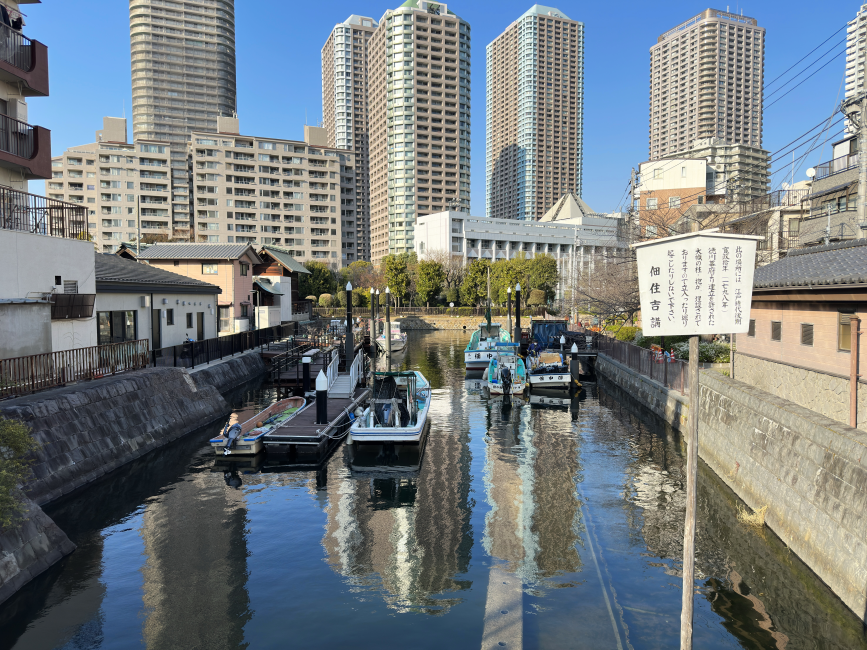
Tower buildings with the moat and the sign indicating the location where the wooden segments are buried on Tsukudajima.
Tower buildings with the moat and the sign indicating the location where the wooden segments are buried on Tsukudajima.
© 2026 Kiuchi Kumiko. Used by permission.
The copyright holder reserves, or holds for their own use, all the rights provided by copyright law, such as distribution, performance, and creation of derivative works.
Kiuchi, Kumiko. “Mapped Futures, Vanishing Places: On Inheritance at the Water’s Edge.” Springs: The Rachel Carson Center Review, no. 10 (July 2026). https://doi.org/10.5282/rcc-springs-23588.
I began thinking about the inheritance of memory not in a classroom or a library, but at the edge of a half-closed moat on Tsukudajima, an artificial island in Tokyo. Some might imagine a concrete island with few signs of life, but, in fact, it is rich in colors, activities, and species. I walk by the moat every day. Before dawn, it remains plunged in a muted Maastricht blue, sharpening a shrine’s silhouette under a slowly waking sky. In rush hour, a couple of boats sail out through a water gate almost as narrow as their width. During the day, people gather along its edge, fishing, waiting for a friend, talking, playing Pokémon Go, or dozing on a bench. In the evening light before dusk, the water mirrors a scarlet–mackerel sky as crows, starlings, cormorants, and egrets hasten away for the night, sensing the rain the next day. (From the article)
This article was originally published in Springs: The Rachel Carson Center Review. Springs is an online publication featuring peer-reviewed articles, creative nonfiction, and artistic contributions that showcases the work of the Rachel Carson Center and its community across the world.
2026 Kumiko Kiuchi

This work is licensed under a Creative Commons Attribution 4.0 International License.
This license refers only to the text and does not include any image rights.
Please see captions in the PDF for individual licenses.